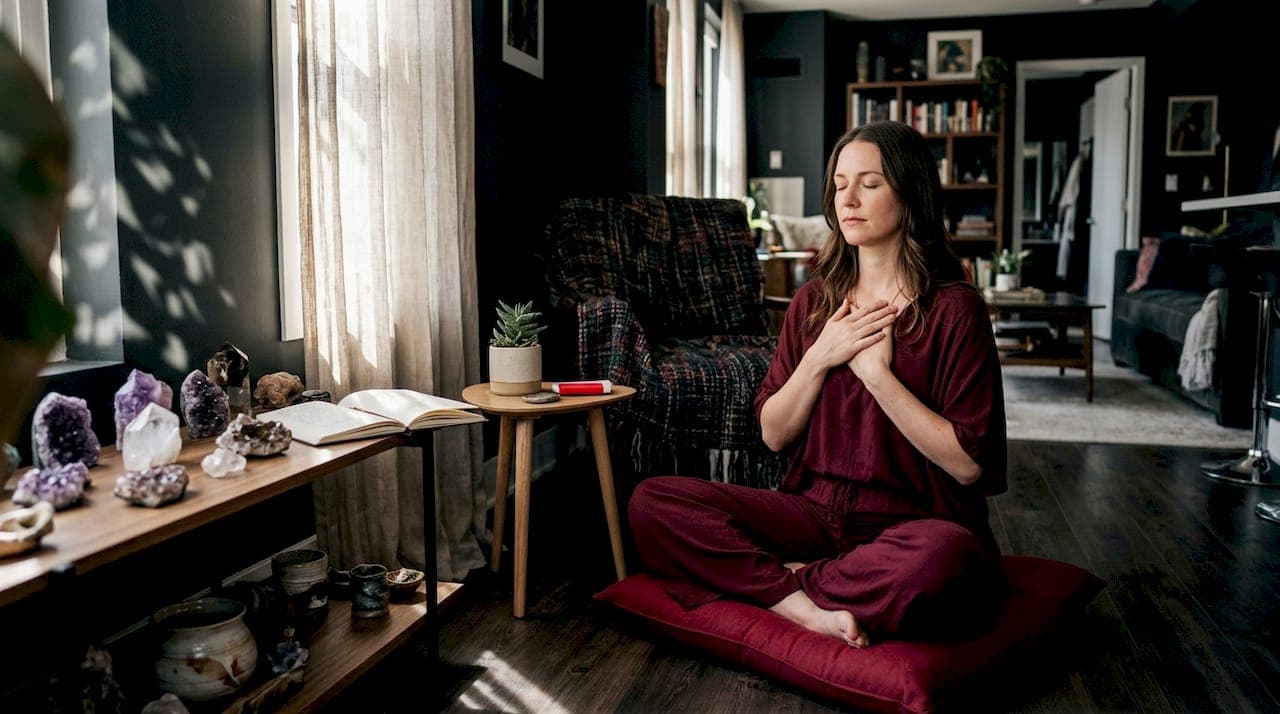
Psychic intuition is defined as the capacity to receive and act on subtle inner signals before conscious reasoning catches up, and it is a trainable skill, not a fixed gift. To develop psychic intuition through daily practice means building a repeatable routine of body scanning, journaling, and short meditation that progressively sharpens your inner knowing. Research confirms that brief daily meditations of just six to seven minutes measurably improve attention and bodily awareness, the two foundations every intuitive skill rests on. Tools like an intuition journal, oracle cards, and a grounding crystal are not decorative props. They are calibration instruments that help you separate real signals from mental noise, week by week.
What daily practices and tools do you need to develop psychic intuition?

The recognised term in psychic development circles for this work is intuition training, and it sits at the intersection of somatic awareness, mindfulness, and esoteric practice. Getting started does not require a dramatic overhaul of your day. It requires consistency with a small set of tools.
The core toolkit looks like this:
- Intuition journal. Record your first impressions immediately, before your rational mind rewrites them. Journaling first impressions without interpretation is the single most reliable way to build accurate calibration over time.
- Meditation timer or app. A smartphone mindfulness app delivering guided meditations without instructor support shows significant psychological benefits and improves adherence. Insight Timer and Calm both offer sessions under ten minutes.
- Oracle cards or a pendulum. These tools externalise your inner yes/no response, making subtle signals visible and easier to track.
- A grounding object. A crystal, a smooth stone, or any physical anchor helps you return to your body when mental chatter gets loud.
| Tool | Primary use | Time needed daily |
|---|---|---|
| Intuition journal | Record and review impressions | 5 minutes |
| Meditation app | Attention and body awareness training | 6 to 10 minutes |
| Oracle cards or pendulum | Externalise intuitive responses | 5 minutes |
| Grounding crystal or object | Somatic anchoring and focus | 1 to 2 minutes |
| Psychic shield visualisation | Energetic boundary conditioning | 3 minutes |
A 3-minute morning shield visualisation combined with a physical anchor can substantially reduce empathic exhaustion when practised daily. This matters because many women who are drawn to intuition work are also highly sensitive, and without an energetic boundary practice, the work can feel draining rather than empowering.
Pro Tip: Start with just two tools: your journal and a six-minute meditation. Add the others in week two once the habit feels natural. Overwhelm kills consistency faster than anything else.
How do you structure a 30-day progressive practice?
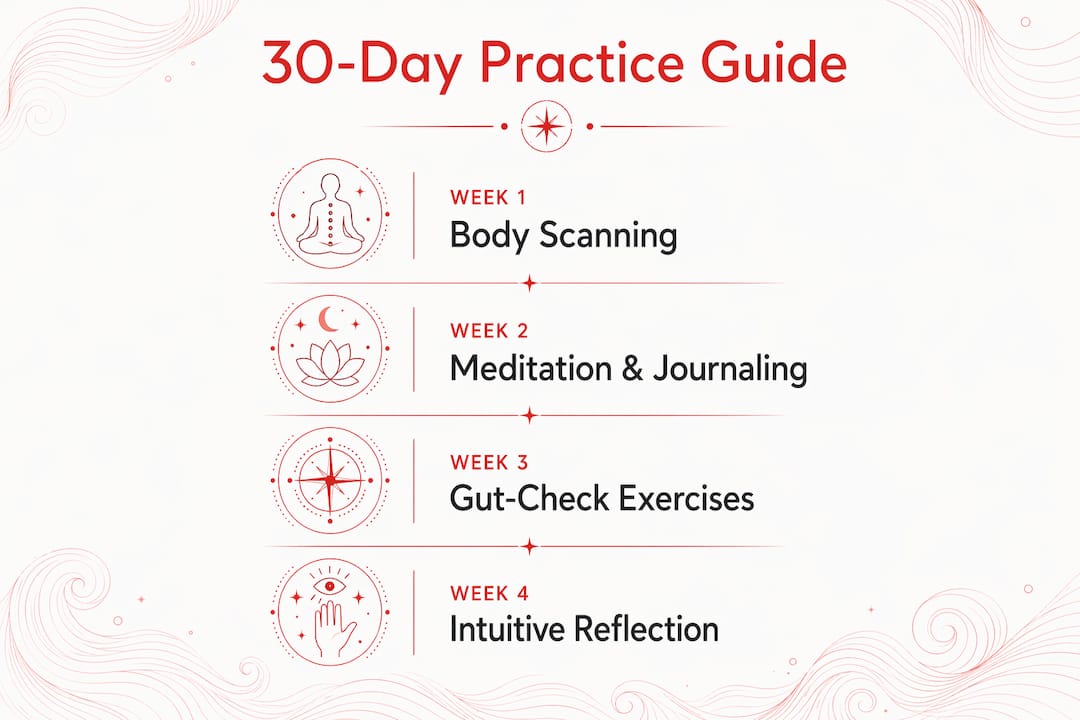
A structured 30-day progression from body scanning to psychometry is the most effective framework for building intuition incrementally. Each week adds one layer of complexity, so your nervous system and your confidence grow together.
Here is how the four weeks unfold:
- Week one: body scanning and gut-checks. Spend two to five minutes each morning checking in with your body. Ask a simple yes/no question and notice where you feel a response physically. A tight chest, a warm belly, a sudden lightness. These are your somatic markers, and training body awareness directly enhances intuitive accuracy within weeks by tuning these signals before conscious reasoning kicks in.
- Week two: pre-cognitive journaling and dream recording. Before you check your phone each morning, write down any impressions, images, or feelings from the night. Then write one intuitive prediction for the day ahead. Review it that evening without judgement.
- Week three: pendulum, oracle cards, and automatic writing. Introduce your external tools. Sit quietly, hold your pendulum or draw a card, and write whatever comes without editing. Body scanning and pendulum use develop physical intuition channels, while automatic writing and visualisation open clairvoyant pathways.
- Week four: psychometry, aura sensing, and visualisation. Hold an object belonging to someone else and write your impressions. Practise softening your gaze and noticing colour or energy around living things. These exercises stretch your range without forcing it.
| Week | Focus | Daily time |
|---|---|---|
| Week 1 | Body scanning and yes/no gut-checks | 5 to 7 minutes |
| Week 2 | Pre-cognitive journaling and dream recording | 10 to 12 minutes |
| Week 3 | Pendulum, oracle cards, automatic writing | 15 minutes |
| Week 4 | Psychometry, aura sensing, visualisation | 15 to 20 minutes |
Pro Tip: At the end of each week, read back through your journal entries and circle the impressions that proved accurate. This feedback loop is what builds genuine trust in your own signals, not wishful thinking.
What mindfulness and meditation techniques best support psychic growth?
Mindfulness is not a soft add-on to psychic development. It is the engine. An 8-week Buddhist mindfulness programme reduced anxiety, improved happiness, and enhanced attention efficiency in young adults, which are exactly the conditions under which intuitive signals become audible. When your mind is cluttered and anxious, genuine impressions get buried under the noise.
Short daily sessions are more sustainable than long occasional ones. The research on app-based mindfulness protocols confirms that six to seven minutes daily is a meaningful low-dose intervention for attention training. That means you do not need an hour on a meditation cushion to see results. You need seven minutes and a commitment to showing up.
The practices that work best alongside intuition training are:
- Body scan meditation. Lie down or sit and move your awareness slowly from your feet to the crown of your head. This trains interoception, your ability to read internal body signals, which is the physiological basis of gut feeling.
- Breath-anchored attention. Follow your breath for five minutes without trying to change it. When your mind wanders, return without self-criticism. This builds the mental muscle that lets you hold an intuitive impression long enough to examine it.
- Self-compassion meditation. Practices drawn from Kristin Neff's self-compassion framework reduce the self-doubt that drowns out intuitive signals. When you trust yourself more, you hear yourself more clearly.
Beginners often find attention to the body unsettling, particularly if they carry trauma. Short practices and external anchors, such as holding a grounding stone or focusing on a candle flame, help manage this and create sustainable routines. If body-focused attention triggers distress, start with sound or breath as your anchor instead.
How do you tell real intuition apart from wishful thinking?
This is the question that stops most people in their tracks, and it deserves a direct answer. True intuitive impressions tend to arrive quietly, without emotional charge, and they do not change when you analyse them. Anxiety and wishful thinking are loud, urgent, and shift depending on your mood.
The most reliable method for distinguishing the two is recording the date, question, and first impression before reviewing the outcome later. This prevents rationalisation bias, the tendency to rewrite your memory of what you sensed to match what actually happened. Over weeks, patterns emerge. You start to recognise the particular quality of a genuine hit versus a fear-driven projection.
"Many traditions recommend building a calmer mental environment first and verifying intuitive impressions gradually rather than forcing access."
Common sources of interference to watch for:
- Anxiety. Anxious impressions feel urgent and catastrophic. They repeat. Genuine intuition tends to state something once and wait.
- Wishful thinking. These impressions feel warm and reassuring regardless of context. They tell you what you want to hear.
- Overthinking. The longer you sit with an impression before writing it down, the more your rational mind edits it. Write first, analyse later.
Tracking intuitive hits and misses in a journal over weeks improves accuracy because feedback is the mechanism of calibration. Without it, you are practising in the dark. Psychic shielding also plays a role here. When you are energetically boundaried, you are less likely to absorb other people's emotions as your own impressions.
Key takeaways
Consistent daily practice combining body awareness, journaling, and short meditation is the most direct path to reliable psychic intuition.
| Point | Details |
|---|---|
| Start with body scanning | Daily somatic check-ins train the interoceptive signals that underpin all intuitive accuracy. |
| Journal before you analyse | Recording first impressions immediately prevents rationalisation bias and builds genuine calibration. |
| Six to seven minutes is enough | Brief daily meditations measurably improve attention and body awareness without requiring long sessions. |
| Build progressively over 30 days | Moving from gut-checks to psychometry week by week prevents overwhelm and builds lasting skill. |
| Use feedback loops | Reviewing hits and misses weekly is what separates developing intuition from wishful thinking. |
What I have learned from years of daily intuitive practice
I want to be honest with you about something most psychic development guides skip entirely. The hardest part is not learning the exercises. It is learning to trust yourself when the signals are quiet and the results are ambiguous. I have sat with my journal on mornings when nothing came through, when I felt like a fraud, when I wondered if any of this was real. And I kept going anyway.
What I have found, over and over, is that the practice works not because you suddenly develop supernatural powers, but because you become quieter inside. You start to hear the part of you that always knew. The woman who felt something was wrong before she had evidence. The one who sensed the right door before she opened it. She was always there. She just needed the noise to come down.
Small daily steps matter more than dramatic breakthroughs. A six-minute meditation and three lines in a journal, done every morning for a month, will change your relationship with your own knowing more than a weekend retreat done once. Sustainability is everything. Keep it short. Keep it kind. And when you miss a day, do not make it mean something. Just begin again.
Integrating spiritual exercises with mindfulness is not about becoming someone different. It is about coming home to who you already are, underneath all the conditioning and the doubt and the years of being told your sensitivity was a problem. It is not a problem. It is your greatest gift.
— Laura
Explore deeper support for your intuitive development
If this resonates with you and you are ready to go further, Lauramaelstrom offers structured courses and one-on-one coaching designed specifically for women who are ready to move from surviving to truly thriving.
The work at Lauramaelstrom weaves together trauma recovery, spiritual mentoring, and practical psychic development tools into a programme that meets you exactly where you are. Whether you are just beginning your daily intuition practice or you have been at it for years and feel stuck, there is support here that goes beyond generic advice. Real tools, real community, and a guide who has walked through the fire herself.
FAQ
What is the best daily exercise to develop psychic intuition?
Body scanning is the most effective starting point because it trains interoception, the physiological basis of gut feeling. Spend five minutes each morning noticing physical sensations in response to a simple yes/no question, then record your impressions in a journal.
How long does it take to improve intuitive skills with daily practice?
Meaningful improvement in body awareness and intuitive accuracy can occur within weeks of consistent daily practice. Research on somatic marker training confirms that tuning body signals before conscious reasoning enhances intuitive accuracy relatively quickly.
Can meditation apps really help with psychic development techniques?
Yes. Smartphone mindfulness apps delivering guided sessions without instructor support show significant psychological benefits and improve adherence to daily practice. Six to seven minutes daily is sufficient to improve the attention and body awareness that underpin intuitive clarity.
How do I know if my intuition is accurate or just anxiety?
Genuine intuitive impressions tend to arrive quietly, without emotional charge, and remain consistent when you return to them. Anxiety-driven impressions feel urgent, repeat insistently, and shift depending on your emotional state. Journaling your first impressions before analysis and reviewing them against outcomes over time is the most reliable calibration method.
Is psychic shielding necessary for daily intuition practice?
Psychic shielding is particularly useful for highly sensitive people who absorb others' emotions as their own signals. A three-minute morning visualisation combined with a physical anchor can reduce empathic exhaustion. It should complement, not replace, professional support if you are working through trauma or anxiety.