
Rewriting your personal narrative is the conscious process of reshaping the story you tell yourself about your life, so that pain becomes a source of power rather than a prison. This is not about pretending the hard things never happened. It is about seeing your whole story, not just the chapters that broke you. Using tools from narrative therapy, cognitive behavioural techniques, and structured writing exercises, you can revise your life narrative from the inside out. This guide walks you through every step, from uncovering your raw, unedited story to rehearsing a new one until it becomes your default truth.
What is a personal narrative and why does it shape you?
Your personal narrative is the internal story you tell yourself about who you are, what has happened to you, and what you deserve. It is not a neutral record of events. It is an interpretation, built from memory, emotion, and the meaning you assigned to moments, often in childhood, often in pain.
This story shapes everything. It influences the decisions you make, the relationships you choose, the risks you take, and the ones you avoid. When the story is built around limiting beliefs, the whole life follows suit. Common examples include:
- "I am too much for people to handle."
- "I always end up alone."
- "I am not clever enough to succeed."
- "Bad things always happen to me."
These are not facts. They are interpretations that hardened into convictions over time. The crucial shift is recognising that narratives are not fixed truths. They are stories, and stories can be rewritten. Narrative therapy, developed by Michael White and David Epston, is built on exactly this premise. It treats the story as separate from the person, which means the person is never the problem. The story is.
That separation matters more than most people realise. When you stop being the damaged woman and start being the woman carrying a story about damage, you reclaim authorship. That is where real change begins.

How to uncover your current personal narrative honestly
Before you can revise your life narrative, you need to see it clearly. Most people have never written their story down. They live inside it, which makes it invisible. Externalising it, getting it out of your head and onto paper, is the first and most important step.
Here is how to do it:
- Set aside 30–45 minutes with no interruptions. Use a notebook or a private document.
- Write your story as you currently tell it, starting from your earliest memories of how life felt. Do not edit. Do not soften. Write the version your inner critic narrates at 3am.
- Include the patterns you notice: the relationships that repeat, the failures that confirm your fears, the moments you felt most like yourself and most unlike yourself.
- Pay close attention to language. Circle every "I can't," "I always," "I never," "I'm just," and "I don't deserve." These are the load-bearing walls of a limiting story.
- Read it back as if a friend wrote it. Notice where you feel compassion and where you feel frustration.
The most valuable narrative draft is the raw, often biased and automatic story you habitually tell yourself, prior to any editing. That rawness is not a flaw. It is the data you need.
Pro Tip: Do not write this draft in one sitting if it feels overwhelming. Write it across three days, one chapter of your life per session. Trauma deserves space, not a deadline.
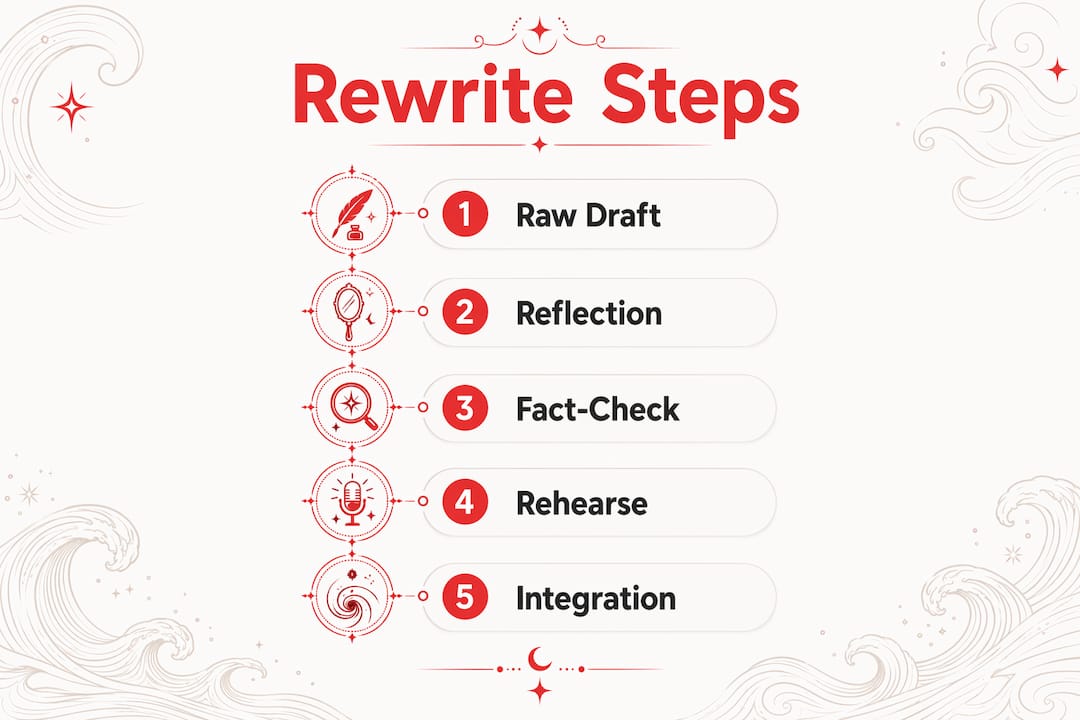
How do you fact-check and examine your current story?
Once you have your raw draft, the real work begins. This stage is about reading your story like a detective, not a judge. You are looking for interpretations disguised as facts, and for the moments of strength your story has quietly omitted.
Ask yourself these questions for each major belief in your narrative:
- Is this a fact, or is it a prediction dressed as a memory?
- What evidence contradicts this belief?
- Who told me this first, and did they have the full picture?
- What did I do in that moment that showed courage, even if it was small?
Narrative therapy calls these overlooked moments "unique outcomes." They are the times you survived something you thought would break you, the times you chose differently, the times you showed up for yourself or someone else against the odds. Your current story has probably buried them.
"Suppressing negative experiences is counterproductive. Instead, integrate painful realities with moments of strength for a nuanced narrative." Psychology Today
The externalisation technique from narrative therapy helps you separate problems from your identity. Instead of "I am broken," you examine "I have been carrying a story about being broken." That shift is not semantic. It is the difference between being trapped and being the one who holds the key.
Do not rush this stage. Sit with each belief for at least a day. Let the contradictions surface. The goal is not to erase the pain. The goal is to thicken the plot, to add the chapters your story forgot to include.
How to write and rehearse your new personal narrative
Now you write the fuller, truer version. This is not a fantasy. It is a more complete account that holds both the real pain and the real resilience. Effective rewrites maintain original facts and pain but add context of resilience and growth to feel authentic.
Follow these steps:
- Begin with what actually happened, without minimising it.
- Add the unique outcomes you uncovered. Write them with the same weight as the painful events.
- Use language of becoming rather than fixed identity. "I am learning to trust myself" carries more truth than "I am a trusting person" when you are still mid-process.
- Include sensory details. What does your new story feel like in your body? What does the version of you who has integrated this pain smell, see, and hear in her daily life? Vivid setting descriptions linked to emotional states make the new narrative feel real and inhabitable, not abstract.
- Read the new story aloud every morning for at least three weeks.
The rehearsal is not optional. Narrative revision is iterative and needs deliberate rehearsal over weeks to make the new story the automatic default. Old stories are neurologically reinforced. They have years of repetition behind them. Your new story needs the same investment, built one day at a time.
A daily technique that works well combines acknowledging the struggle with a small, concrete commitment. You might say: "Today was hard and I still showed up. That is who I am becoming." That pairing of reality and micro-action is what anchors the new narrative in your nervous system.
| Rehearsal Method | Frequency | Purpose |
|---|---|---|
| Read new narrative aloud | Daily, morning | Reinforces new identity language |
| Write one unique outcome | 3 times per week | Builds evidence for the new story |
| Pair struggle with micro-action | Daily, evening | Anchors resilience in real behaviour |
| Review and revise narrative | Once per month | Allows story to evolve with growth |
When the old narrative intrudes, and it will, do not fight it. Acknowledge it: "There is the old story again." Then return to your new one. Resistance feeds the old pattern. Gentle redirection rewires it.
What are the common pitfalls in narrative rewriting?
The most common mistake is forcing positivity. Women who have survived real trauma are often told to "think positive" or "focus on the good." That advice, without the groundwork of honest examination, produces a brittle, inauthentic story that collapses under pressure.
Watch out for these pitfalls:
- Skipping the raw draft and writing only the version you wish were true.
- Erasing painful events instead of integrating them with context and growth.
- Expecting the new story to feel natural immediately. It will feel false at first. That is normal.
- Giving up after one bad day when the old narrative floods back.
- Treating the process as a one-time exercise rather than an ongoing practice.
Incorporating both pain and positive growth prevents inauthentic, overly optimistic rewrites. The goal is not a highlight reel. It is a full human story, one that includes the worst chapters and the moments you did not give up. That is the story worth telling. That is the one that heals.
If you find the emotional weight too heavy to carry alone, working with a counsellor trained in narrative therapy or personalised recovery approaches can provide the structure and safety you need to go deeper without becoming overwhelmed.
Key takeaways
Rewriting your personal narrative requires honest examination of your current story, deliberate integration of overlooked resilience, and daily rehearsal over weeks to make the new story your default.
| Point | Details |
|---|---|
| Start with the raw story | Write your unedited, automatic narrative before attempting any revision. |
| Fact-check your beliefs | Separate interpretations from facts and locate overlooked moments of strength. |
| Write a fuller, truer version | Include both real pain and real resilience to create an authentic new narrative. |
| Rehearse daily for weeks | Repeat the new story every morning to rewire your neurological default. |
| Expect the process to be iterative | Old narratives will intrude. Gentle redirection, not resistance, creates lasting change. |
The uncomfortable truth about changing your story
I have rewritten my own story more times than I can count. And I will tell you something that most guides leave out: the first time you read your new narrative aloud, it will feel like a lie. Not because it is false, but because the old story has had so much more practice.
I spent years carrying a story about being too much, too broken, too complicated to be loved well. That story had evidence. Real evidence. And when I first tried to write a different version, it felt hollow, like I was performing optimism I did not feel. What changed everything was not positive thinking. It was the moment I stopped trying to erase the hard parts and started writing them in with the same ink as the good ones.
The women I work with through Lauramaelstrom often arrive believing their story is simply the truth. They have confused the interpretation with the event. That confusion is not weakness. It is what happens when pain goes unwitnessed for long enough. The work of rewriting is the work of becoming your own witness, finally, honestly, and with enough compassion to hold the whole picture.
This process is slow. It is supposed to be slow. From the worst soil comes the most extraordinary growth, but only if you give it time. Be patient with yourself. The new story is already in you. You are just learning to tell it.
— Laura
Ready to go deeper into your story?
If this process has stirred something in you, that is not an accident. That stirring is the part of you that knows a different story is possible.
Lauramaelstrom offers coaching, courses, and community specifically designed for women who are ready to move from surviving to truly living. The work integrates narrative identity, trauma recovery, and spiritual depth in ways that go far beyond surface-level positivity. If you are ready to stop circling the same painful chapters and start writing new ones, explore the full range of resources at Lauramaelstrom. Your story is not finished. The most powerful chapters are still ahead.
FAQ
What does rewriting your personal narrative actually mean?
Rewriting your personal narrative means consciously reshaping the internal story you tell yourself about your life, your identity, and your worth. It does not erase the past but integrates pain with resilience to create a fuller, more empowering account.
How long does it take to change your personal narrative?
Changing an ingrained personal story takes weeks of daily practice to rewire neural pathways. Expect the process to feel uncomfortable at first and to require consistent rehearsal before the new story feels natural.
Is narrative therapy the same as positive thinking?
Narrative therapy is not positive thinking. It retains the real, painful facts of your story and adds overlooked context, such as moments of strength and resilience, to create a more complete and authentic account rather than an artificially optimistic one.
Where do i start if my story feels too painful to write?
Start with the raw draft, writing without editing or censoring, and allow yourself to write across several days rather than in one sitting. If the emotional weight feels unmanageable, a counsellor trained in narrative therapy can provide safe, structured support.
Can i rewrite my narrative on my own without professional help?
Yes, many people begin this process independently using structured writing exercises and daily rehearsal techniques. Professional support becomes especially valuable when trauma is severe or when the old narrative feels impossible to separate from your sense of self.