
Intentional life design is the deliberate act of shaping your life in alignment with your values and purpose through ongoing reflection, experimentation, and adjustment. It is not a single plan you write once and follow forever. It is a living, breathing process, one that borrows from design thinking and asks you to treat your own existence as a prototype worth testing, refining, and rebuilding when necessary. Bill Burnett and Dave Evans, who created the Stanford Life Design Lab, popularised this approach through their work and their book Designing Your Life, arguing that meaning is designed, not discovered. That single shift changes everything.
What is intentional life design and why does it matter?
Intentional life design means proactively aligning your life choices with your personal values and purpose, using experimentation and iteration rather than fixed plans. Most people live by default. They take the job that appears, stay in the relationship that is familiar, and drift through decades without ever asking whether any of it actually fits. Intentional life design is the antidote to that drift.
The concept draws directly from design thinking, a problem-solving methodology used in fields like architecture, product development, and engineering. When applied to life, it treats you as both the designer and the project. You gather data about yourself, identify what is working and what is not, generate multiple possible futures, and test them in small, low-risk ways before committing. This is what purposeful living looks like in practice.

What makes this approach different from traditional self-help is the emphasis on iteration over perfection. You are not searching for the one right answer. You are running experiments, learning from them, and adjusting course. Living by design invites you to approach life as an ongoing project subject to learning, not a destination you either reach or fail to reach.
How do design-thinking principles apply to your life?
Design thinking rests on five core mindsets, and each one translates directly into how you build an intentional life. Understanding them is not abstract theory. It is the operating system beneath every practical tool in this field.
-
Curiosity. Curiosity is the starting point. Before you can design anything, you need to explore without judgement. This means asking questions about your current life with genuine openness, not defensiveness. What drains you? What lights you up? What patterns keep repeating? Curiosity turns those questions into useful data rather than sources of shame.
-
Prototyping. Rather than waiting until you have perfect information, you run small experiments. You try a new morning routine for two weeks. You take on a freelance project before quitting your job. You attend one class before enrolling in a full programme. Small experiments generate evidence that no amount of planning alone can produce.
-
Reframing obstacles. When something does not work, the design-thinking response is to treat it as information, not failure. A job that felt wrong tells you something about your values. A relationship that ended teaches you about your needs. Reframing setbacks as data keeps momentum alive and replaces discouragement with learning.
-
Bias toward action. Over-planning is one of the most common traps in personal development. A bias toward action means you move before you feel fully ready, because readiness is often a feeling that never fully arrives.
-
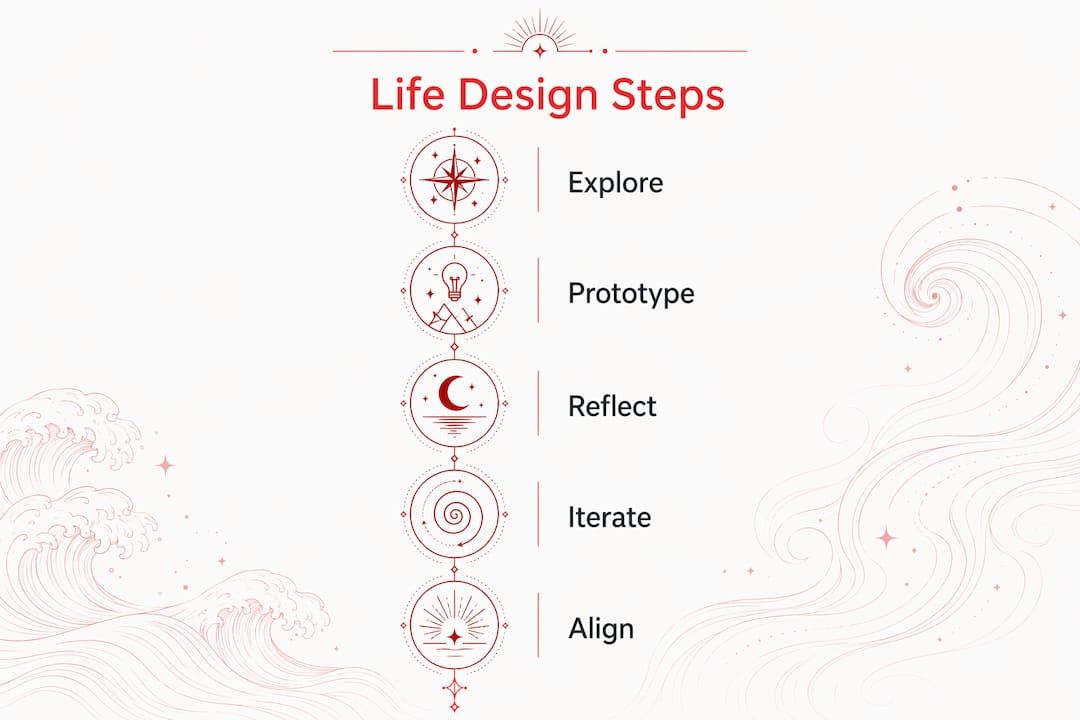
Iterative reflection. You do not design your life once. You revisit, reassess, and adjust. Regular reflection cycles, whether weekly or monthly, keep your choices aligned with who you are becoming rather than who you were when you started.
Pro Tip: Set a recurring fifteen-minute weekly review in your calendar. Ask three questions: What felt aligned this week? What felt off? What one small thing will I test next week? This single habit builds the feedback loop that intentional life design depends on.
Research confirms that these design mindsets increase agency, resilience, and self-efficacy, particularly when navigating uncertainty. That is not a small thing. Those are the exact qualities that determine whether you thrive or merely survive.
What frameworks and methods actually work?
Knowing the principles is one thing. Having practical tools to apply them is another. Several frameworks have emerged from the Stanford Life Design Lab and related practitioners that give structure to the process of building an intentional life.
-
The Odysseys exercise. Developed by Burnett and Evans, this tool asks you to prototype three futures simultaneously. The first is your Expected path, the life you are already on. The second is an Alternative path, what you would do if your current route disappeared. The third is a Wild Card, the life you would live if no one was watching and failure was impossible. Writing out all three breaks the illusion that there is only one right answer and opens genuine creative space.
-
Taking stock across life areas. Before designing anything new, you assess where you are now. This means honestly evaluating four domains: work, play, love, and health. You rate your current satisfaction in each area without judgement. This snapshot reveals where energy is flowing and where it is being drained, giving you a clear starting point rather than a vague sense of dissatisfaction.
-
Values-aligned goal setting. Standard SMART goals focus on measurability and timelines. Life design goes deeper by anchoring goals to your actual values. A goal to "earn more money" becomes "build financial security so I can spend more time with my children and take creative risks." The values give the goal its real weight and staying power.
-
Feedback loops and regular reviews. Weekly reflections maintain coherence between your daily actions and your larger intentions. Without them, even the most thoughtful design drifts back toward default living within weeks.
-
Everyday intentional living practices. These are the micro-habits that reinforce your design: journalling, mindful decision-making, saying no to commitments that conflict with your values, and deliberately choosing how you spend unstructured time.
Here is a quick comparison of how life design frameworks differ in their focus:
| Framework | Core focus | Best used for |
|---|---|---|
| Odysseys prototyping | Exploring multiple futures | Breaking out of a single fixed path |
| Life area audit | Current satisfaction mapping | Identifying where change is most needed |
| Values-aligned goals | Anchoring goals to purpose | Sustaining motivation over the long term |
| Weekly reflection loops | Ongoing alignment checks | Catching drift before it becomes a crisis |
How does intentional life design differ from related concepts?
People often conflate intentional life design with goal-setting, minimalism, or general self-improvement. They are related but distinct, and the differences matter.
| Concept | Core mechanism | Key limitation |
|---|---|---|
| Traditional goal-setting | Fixed targets with deadlines | Assumes you know what you want before you experiment |
| Minimalism | Reducing possessions and commitments | Focuses on subtraction, not on designing what replaces it |
| Default living | Accepting circumstances as they come | No active shaping of direction or values alignment |
| Intentional life design | Iterative prototyping aligned to values | Requires ongoing effort and honest self-reflection |
Traditional goal-setting assumes you already know what you want. You set a target, work toward it, and either succeed or fail. Life design challenges that assumption entirely. The future is data-poor, which means you cannot plan your way to certainty. You can only experiment your way toward clarity.
Minimalism, popularised by writers like Joshua Fields Millburn and Ryan Nicodemus of The Minimalists, focuses on removing what does not serve you. That is a valuable practice. But it does not tell you what to build in the space that clearing creates. Life design fills that gap.
Living by default is not laziness. It is often the result of never having been shown another way. Many people simply absorb the expectations of their family, culture, or circumstance and call it a life. Intentional life design is the practice of waking up to that pattern and choosing differently, one small experiment at a time.
How to start practising intentional life design today
You do not need a retreat, a coach, or a complete life overhaul to begin. You need awareness, honesty, and a willingness to start small.
-
Start with a life audit. Spend thirty minutes writing honestly about your current patterns. Where do you spend your time? Where does your energy go? What do you keep tolerating that you know, deep down, does not fit who you want to be?
-
Choose one area to focus on. Trying to redesign everything at once leads to paralysis. Pick one domain, whether work, relationships, health, or creativity, and give it your full attention for the next four to six weeks.
-
Brainstorm multiple pathways. For your chosen area, generate at least three different possible directions. Do not edit yourself. Write down the sensible option, the scary option, and the one that makes you feel alive just thinking about it.
-
Run one small experiment. Choose the smallest possible version of one pathway and test it in real life. If you are curious about a career change, spend one Saturday doing the actual work before you hand in your notice. If you want more connection, invite one person for coffee before you commit to a weekly social programme.
-
Reflect and adjust. After your experiment, ask what you learned. Not whether it worked perfectly, but what the experience told you about yourself. That data shapes your next prototype.
Pro Tip: Keep a simple design journal. After each experiment, write three sentences: what you tried, what you noticed, and what you will do differently next time. Over months, this becomes a map of your own growth that no personality test can replicate.
Meaning is actively designed through deliberate practice and experimentation, not stumbled upon by waiting for the right moment. The right moment is built, not found.
Key takeaways
Intentional life design works because it replaces passive drifting with active, values-led experimentation that generates real evidence about what a fulfilling life looks like for you.
| Point | Details |
|---|---|
| Design thinking as foundation | Curiosity, prototyping, and reframing obstacles are the core mindsets that make life design work. |
| Iteration over perfection | Life design is a continuous process of small experiments and adjustments, not a single fixed plan. |
| Odysseys prototyping | Mapping three simultaneous futures breaks the illusion of a single right path and opens genuine choice. |
| Weekly reflection loops | Regular alignment checks prevent drift and keep daily actions connected to deeper values and purpose. |
| Start small and specific | Choosing one life area and running one small experiment is more effective than overhauling everything at once. |
Why I stopped waiting for the perfect plan
I spent years believing that if I thought hard enough, planned carefully enough, and waited long enough, the right life would eventually reveal itself. It did not. What I found instead was that the life I wanted had to be built, messily and imperfectly, through action rather than analysis.
The most liberating shift I ever made was treating a failed attempt not as evidence that I was broken, but as data. I tried a business idea that flopped. I moved to a city that felt wrong within six months. I stayed in a relationship far longer than my gut told me to. Each of those experiences, painful as they were, gave me information I could not have gathered any other way. They shaped the next prototype.
What I see most often in the women I work with is not a lack of desire for change. It is a terror of getting it wrong. They over-plan, over-research, and over-think until the window of possibility feels closed. The truth is, there is no getting it wrong when you treat your life as a design project. There is only learning what works and what does not, and adjusting accordingly.
The gardening metaphor I return to again and again is this: from the worst shit comes the sweetest roses. The failures, the detours, the seasons that felt like pure loss, those are the compost. They are not wasted. They are the very material your next, truer life is built from. Stop waiting for the perfect conditions. Start planting.
— Laura
Ready to design a life that actually fits you?
If something in this article stirred something in you, that is not an accident. That feeling is data too.
At Lauramaelstrom, the work goes deeper than frameworks and exercises. It combines the practical tools of life design with trauma-informed coaching, spiritual mentoring, and the kind of honest, raw support that helps you not just plan a new life, but actually live it. Whether you are stuck in old patterns, recovering from wounds that keep pulling you back, or simply ready to stop surviving and start thriving, there is a place for you here. Come and explore what is possible.
FAQ
What is intentional life design in simple terms?
Intentional life design is the practice of proactively shaping your life around your values and purpose through ongoing reflection and small experiments, rather than drifting through life by default or following a fixed plan.
How does life design differ from traditional goal-setting?
Traditional goal-setting assumes you already know what you want and sets fixed targets to reach it. Life design acknowledges that the future is uncertain and uses iterative prototyping to discover what you want through real-world experience.
What is the Odysseys exercise in life design?
The Odysseys exercise, developed by the Stanford Life Design Lab, asks you to prototype three simultaneous futures: your Expected path, an Alternative path, and a Wild Card. This reveals that multiple fulfilling lives are possible and breaks the paralysis of searching for one right answer.
How often should I review my life design?
Weekly reflections are recommended to maintain alignment between your daily actions and your deeper intentions. Regular reviews catch drift early, before small misalignments become large regrets.
Can intentional life design help with trauma recovery?
Yes. The iterative, non-judgemental approach of life design, which treats setbacks as data rather than failure, aligns well with trauma recovery work. It creates space for gradual, sustainable change rather than demanding sudden transformation.